Public Course
Learn alongside leaders from other plants at a scheduled location. Lunch and refreshments are included each day.
See course locationsPractical · Plant-focused · Built from experience
A 3-day workshop on leading reliability improvement
You are expected to improve production, manage costs, support your people, and prepare the operation for what comes next. Then the day changes. A familiar piece of equipment fails, planned work gets pushed aside, and the improvement you wanted waits another week.
Over three days with Jeff Parker, learn how to make a stronger case for improvement, choose priorities that fit your plant, and build the support and follow-through needed to make progress last.
The workshop expands on The Reliable Method: What Separates the Best Plants from the Rest.
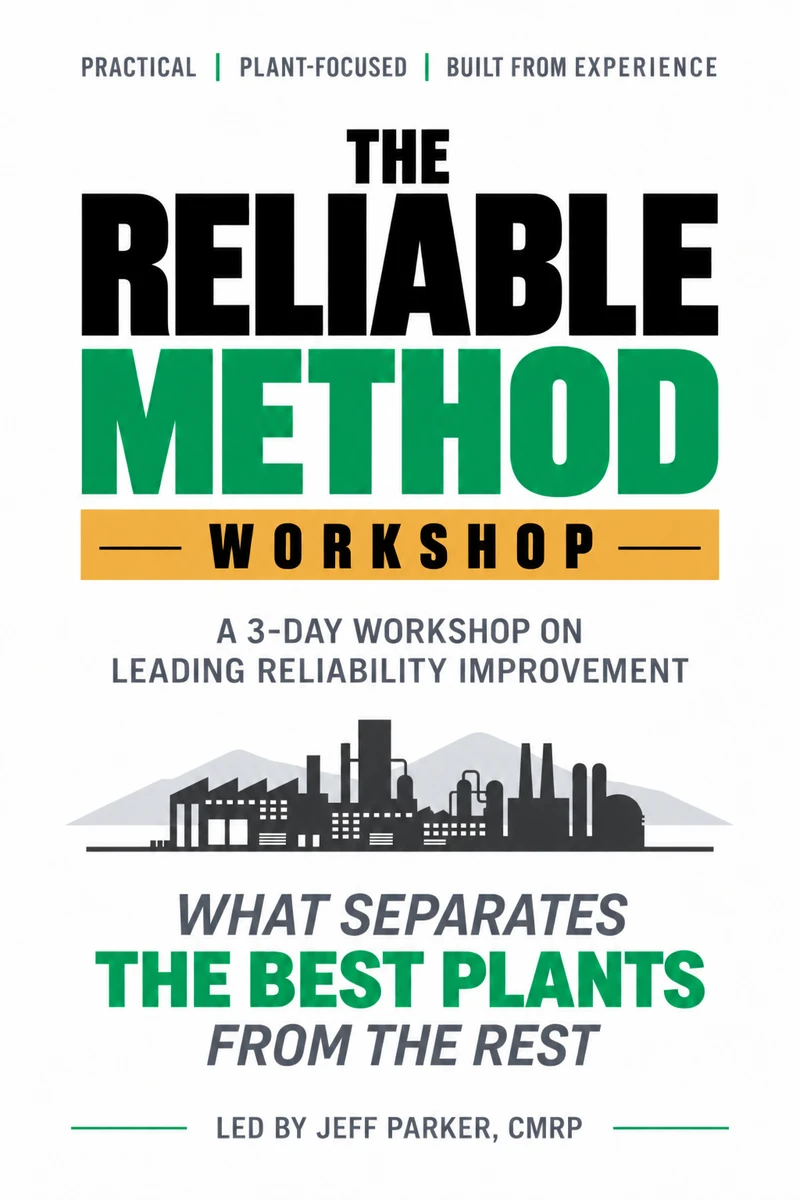
It is the same 3-day workshop. Choose the setting that fits your team.
Learn alongside leaders from other plants at a scheduled location. Lunch and refreshments are included each day.
See course locationsThe same workshop, at your plant or the location of your choice. Call or email to talk through dates and what your team needs.
Ask about on-siteComing soon
An online version of the workshop is in development. It is not open for enrollment yet.
On-demand statusUpcoming locations and dates.
May 11–13, 2027
Tuesday–Thursday
Venture X – Dallas / Addison
17250 Dallas Pkwy$1,895 per student
July 27–29, 2027
Tuesday–Thursday
Builders Exchange of Kentucky
2300 Meadow Dr, Suite 100$1,895 per student
Questions about public courses
Call or email with a question about a date, location, or registration.
Bring the workshop to your plant or the location of your choice.
It is the same 3-day workshop, led by Jeff Parker, for the people who share the decisions in your organization. Hold it at your facility or another location that works for your team. In-person attendees receive a certificate of completion.
Call or email to inquire. We’ll talk through dates, location, the group, and what your team needs from the three days.
Phone
(412) 336-3223You can also use the contact form and tell us you want the workshop on-site.
The online course is coming soon.
An on-demand version of The Reliable Method Workshop is in development. It is not open for enrollment yet.
Public and on-site are the ways to take the workshop now. If you want to hear when the online course opens, call (412) 336-3223 or email crew@reliamag.com.
Brochure
Eight pages: why to attend, what you will learn, the three-day outline, who should attend, and Jeff Parker’s background.
By the end of a reactive day, the team has worked hard and the plant is running again. The same problems are still waiting to be solved.
That cycle costs more than downtime. It consumes the time, attention, and capacity the organization needs to get better.
For plant, maintenance, reliability, operations, and engineering leaders ready to build a more dependable operation.
01
Recognize the gaps behind recurring problems.
02
Focus resources on priorities that fit your starting point.
03
Put ownership, support, and follow-through around those priorities.
Reactivity ties up capacity. Reliability puts it to work.
Where should we start?
How do we justify the investment?
Who needs to own the work?
Why are we still dealing with the same problems?
The workshop helps you answer those questions with a clearer view of your operation and a more practical approach to improvement.
Connect reliability to the outcomes management and finance care about, including productive capacity, cost per unit, safety, environmental performance, customer commitments, and employee engagement.
Recognize your operation’s starting point, understand the dependencies between improvement activities, and choose a sequence that helps your efforts build on one another.
See how maintenance strategies, work management, engineering, and operating practices connect, and identify where coordination or resource gaps are limiting results.
Clarify the commitments needed from production, maintenance, engineering, and management so improvement has support across the operation.
Use measures to identify barriers, assign responsibility, and follow actions through to results that matter on the floor.
Protect future-focused work, strengthen stakeholder support, and reinforce the practices that help your team stay ahead of recurring problems.
An initial set to review and refine with your team.
Prerequisites and first actions.
Proposed ownership, resources, and support.
Follow-up and review.
Here is where we are getting stuck. Here is what deserves attention next. Here is what we need to make it happen.
Three days, six sessions. Each day ends with what you take back to your plant.
Day 1
Make a stronger case for support and focus your effort where your operation needs it most.
The business case for reliability
Getting support for reliability starts with explaining what the business stands to gain. Learn how to connect equipment performance to the priorities already on management’s agenda and present a credible case for the investment required.
The aim is to make the value of reliability easier to explain and the commitment required easier to understand. Early investment and later maintenance savings need to be considered together.
The Reliable Method and your starting point
A plant can have capable people and worthwhile initiatives while still struggling to get ahead. Learn how to look across the operation, recognize what is holding progress back, and choose an appropriate starting point.
Make your next investment fit your starting point.
What you take back: a stronger case for resources, and a clearer starting point.
What would a more reliable operation make possible for your business, and where should you start?
Day 2
Understand where work loses momentum and how to keep the whole operation moving toward the same result.
The five categories of The Reliable Method
Your plant may already have many of the capabilities it needs. Getting more value from them requires understanding how they connect and what each needs from the rest of the operation.
Turn identified needs into completed work.
Build reliability in before startup.
Address the causes of recurring failures.
Operational Reliability Discipline covers metrics, ownership, and follow-through. Foundational Elements cover assets, criticality, strategies, spares, standards, and roles.
Examples connect maintenance strategies, planning, scheduling, precision execution, and engineering decisions to the support needed for good work to produce better results.
Operational reliability discipline
A meeting should help work move forward. A metric should help people make a better decision. Learn how to give daily, weekly, and monthly routines a clear purpose and make progress visible across departments.
Connect leading and lagging indicators to execution, equipment performance, and business results.
Give operating discussions and improvement reviews a clear purpose, with the right people involved.
Establish owners, due dates, follow-up, and a practical way to bring unresolved barriers to the people who can remove them.
What you take back: a way to connect priorities, owners, and follow-through so more work gets finished.
What is keeping your people’s best efforts from becoming more dependable plant performance?
Day 3
Build the support and follow-through that help improvement hold up under operating pressure.
Leading the change
A promising improvement effort eventually meets a difficult week. Production pressure rises. Resources get stretched. Familiar ways of working become attractive again. Learn how to prepare for those moments and strengthen the commitment behind the work.
The focus is on making support visible in everyday decisions so improvement can continue as the plant manages its operating demands.
Sequencing, ownership, and follow-through
A clear, manageable set of priorities gives your team something it can act on and follow through. Learn how to turn a broad set of opportunities into a practical starting point that fits your operation.
Bring these ideas together in an initial set of three to five improvement priorities for review with your team.
Illustrative example
Example priority: Protect two planning blocks next week.
Maintenance manager
Coverage for urgent requests during those blocks.
Reserve the blocks. Review interruptions and completed plans on Friday.
What you take back: three to five initial priorities, with proposed owners, first actions, and support needs.
What will you put in motion first, and how will you keep it moving?
Consider a problem your team finds early. The condition is identified. The work request is written. Then the repair waits for planning time, a part, an equipment window, or a decision about competing priorities.
The technical knowledge exists. Turning that knowledge into a completed repair depends on how the organization works.
| What your team has | What helps it deliver |
|---|---|
| Predictive findings | Time, parts, and an equipment window |
| Engineering solutions | Funding, ownership, and implementation |
| Capital projects | Reliability requirements carried through design and startup |
The workshop helps you understand those connections and make better decisions about what they need. You gain a way to connect specialized capabilities to business priorities, recognize where progress is being limited, and help departments work toward a shared result.
The workshop is for people responsible for plant performance, improvement priorities, resources, and execution across departments.
Connect reliability to production commitments, operating costs, and capacity to improve.
Build the case for resources and stronger maintenance execution.
Connect improvement priorities, ownership, and business results.
Strengthen equipment readiness and dependable production.
Connect capital and reliability decisions to long-term operating value.
Bring the people who share the decisions. Return with a clearer basis for agreeing on priorities, committing resources, and supporting execution.

Work Reliable.